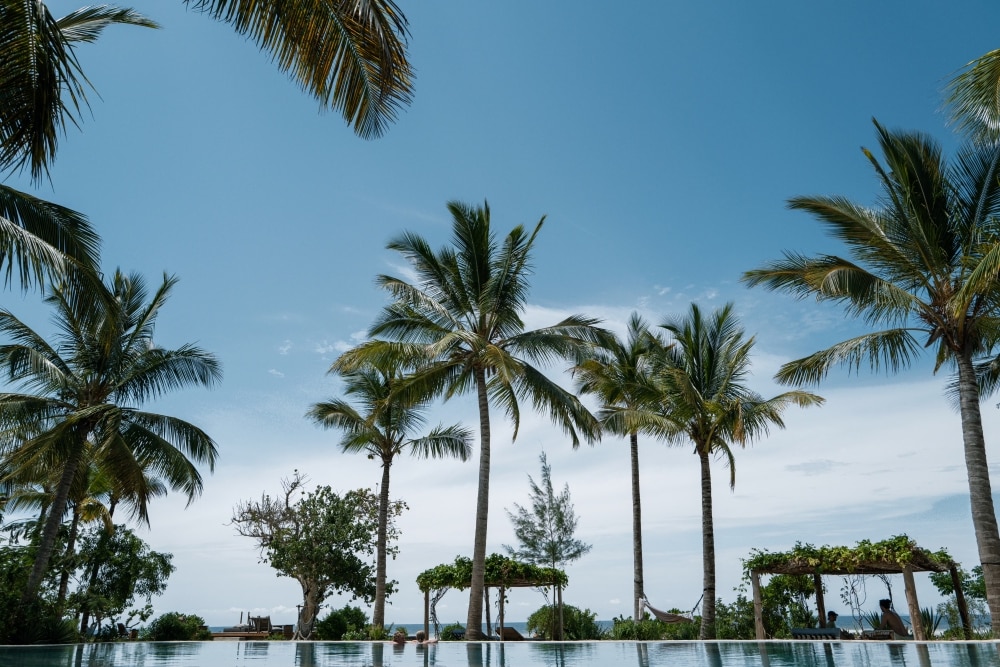
Centro città di Solo

Surakarta

At the museum no photos are allowed which is really unfortunate as it was well worth the visit and the guided tour is definitely not to be missed. In the museum there are even Batik made from the Dutch era which depicts stories like Little Red Riding Hood and Snow White!

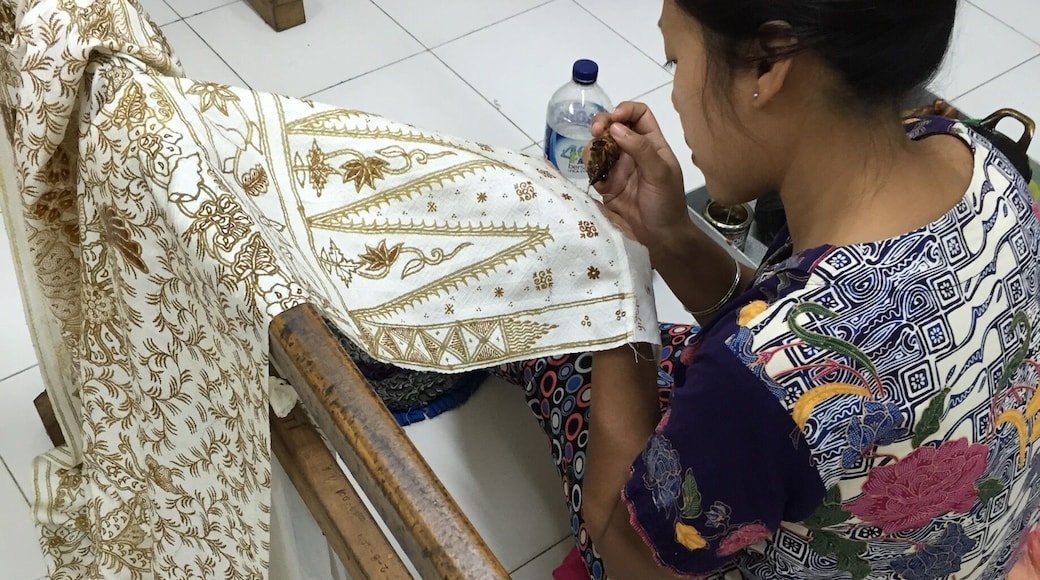
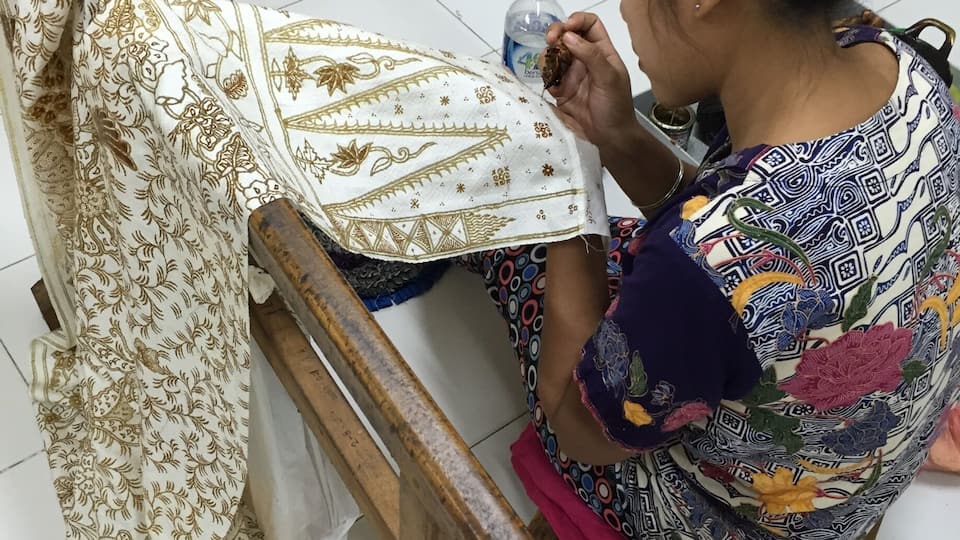
I enjoyed the tour v much and at the end of the tour we were brought to this room where the artisan were working on hand drawn batik.

Below is an excerpt from Wikipedia for anyone interested in learning more about the process of batik making.

Firstly, a cloth is washed, soaked and beaten with a large mallet. Patterns are drawn with pencil and later redrawn using hot wax, usually made from a mixture of paraffin or bees wax, sometimes mixed with plant resins, which functions as a dye-resist. The wax can be applied with a variety of tools. A pen-like instrument called a canting (IPA: [tʃantiŋ], sometimes spelled with old Dutch orthography tjanting) is the most common. A canting is made from a small copper reservoir with a spout on a wooden handle. The reservoir holds the resist which flows through the spout, creating dots and lines as it moves. For larger patterns, a stiff brush may be used. Alternatively, a copper block stamp called a cap (IPA: [tʃap]; old spelling tjap) is used to cover large areas more efficiently.

After the cloth is dry, the resist is removed by scraping or boiling the cloth. The areas treated with resist keep their original color; when the resist is removed the contrast between the dyed and undyed areas forms the pattern. This process is repeated as many times as the number of colors desired.

The most traditional type of batik, called batik tulis (written batik), is drawn using only the canting. The cloth need to be drawn on both sides and dipped in a dye bath three to four times. The whole process may take up to a year; it yields considerably finer patterns than stamped batik.

Source: Wikipedia
At the museum no photos are allowed which is really unfortunate as it was well worth the visit and the guided tour is definitely not to be missed. In the museum there are even Batik made from the Dutch era which depicts stories like Little Red Riding Hood and Snow White!

I enjoyed the tour v much and at the end of the tour we were brought to this room where the artisan were working on hand drawn batik.

Below is an excerpt from Wikipedia for anyone interested in learning more about the process of batik making.

Firstly, a cloth is washed, soaked and beaten with a large mallet. Patterns are drawn with pencil and later redrawn using hot wax, usually made from a mixture of paraffin or bees wax, sometimes mixed with plant resins, which functions as a dye-resist. The wax can be applied with a variety of tools. A pen-like instrument called a canting (IPA: [tʃantiŋ], sometimes spelled with old Dutch orthography tjanting) is the most common. A canting is made from a small copper reservoir with a spout on a wooden handle. The reservoir holds the resist which flows through the spout, creating dots and lines as it moves. For larger patterns, a stiff brush may be used. Alternatively, a copper block stamp called a cap (IPA: [tʃap]; old spelling tjap) is used to cover large areas more efficiently.

After the cloth is dry, the resist is removed by scraping or boiling the cloth. The areas treated with resist keep their original color; when the resist is removed the contrast between the dyed and undyed areas forms the pattern. This process is repeated as many times as the number of colors desired.

The most traditional type of batik, called batik tulis (written batik), is drawn using only the canting. The cloth need to be drawn on both sides and dipped in a dye bath three to four times. The whole process may take up to a year; it yields considerably finer patterns than stamped batik.

Source: Wikipedia

Luoghi di interesse da non perdere

Cose da fare


Centro città di Solo: hotel con le migliori recensioni

The Royal Surakarta Heritage - Handwritten Collection

The Royal Surakarta Heritage - Handwritten Collection

5 out of 5
Jalan Slamet Riyadi No. 06 Surakarta Central Java
Completamente rimborsabilePaga più tardi
Il prezzo è 29 € a notte nel periodo 28 feb - 1 mar
29 €
a notte
28 feb - 1 mar
Alloggia in questo hotel di lusso a Surakarta. Potrai approfittare di utili servizi come il Wi-Fi gratuito, un parcheggio gratuito e una spa completamente attrezzata. ...
8,2/10 Very Good! (168 recensioni)
Pomposo con poco gusto ma soprattutto sporco e carente in manutenzione

Recensione del 22 ago 2015

The Royal Surakarta Heritage - Handwritten Collection
Novotel Solo

Novotel Solo

4 out of 5
Jalan Slamet Riyadi 272 Surakarta Central Java
Il prezzo è 30 € a notte nel periodo 25 feb - 26 feb
30 €
a notte
25 feb - 26 feb
Alloggia in questo hotel con spa a Surakarta. Potrai approfittare di utili servizi come il Wi-Fi gratuito, un parcheggio gratuito e 2 piscine all'aperto. Nelle ...
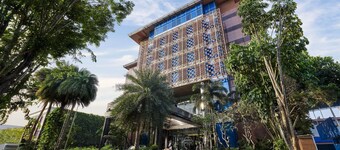
Novotel Solo
ibis Styles Solo

ibis Styles Solo

3 out of 5
Jalan Gajah Mada 23 Surakarta Central Java
Il prezzo è 22 € a notte nel periodo 10 mar - 11 mar
22 €
a notte
10 mar - 11 mar
Alloggia in questo hotel con spa a Surakarta. Potrai approfittare di utili servizi come il Wi-Fi gratuito, un parcheggio gratuito e 2 piscine all'aperto. Nelle ...
8,2/10 Very Good! (103 recensioni)
Nice stay
Camera pulita e confortevole, buona colazione, posizione non lontano da stazione, staff gentile

Recensione del 8 lug 2018

ibis Styles Solo
FIM by Zigna

FIM by Zigna

3 out of 5
31 Jl. Yosodipuro Surakarta Jawa Tengah
Alloggia in questo hotel con spa a Surakarta. Potrai approfittare di utili servizi come il Wi-Fi gratuito, un parcheggio gratuito e una spa completamente attrezzata. ...
9,4/10 Exceptional! (6 recensioni)
The hotel is an excellent place to stay. The hotel itself is not special or fancy, but it is well-run, clean, and located in the center of Solo. The breakfast buffet is excellent, the restaurant is good, and the hotel also has a nice cafe with an outside seating area. They featured life music at ...

Recensione del 19 lug 2025

FIM by Zigna
Comfort Centre Residence Solo

Comfort Centre Residence Solo

2 out of 5
Jalan RM. Said Surakarta Jawa Tengah
Il prezzo è 16 € a notte nel periodo 1 mar - 2 mar
16 €
a notte
1 mar - 2 mar
Soggiorna in questo hotel a Surakarta. Potrai approfittare di utili servizi come il Wi-Fi gratuito, un parcheggio gratuito e una reception aperta 24 ore su 24. ...
Comfort Centre Residence Solo
Loji Hotel Solo by Wstay

Loji Hotel Solo by Wstay

3 out of 5
Jl. Hasanudin 134, Surakarta Surakarta Central Java
Il prezzo è 14 € a notte nel periodo 24 feb - 25 feb
14 €
a notte
24 feb - 25 feb
Alloggia in questo hotel con spa a Surakarta. Potrai approfittare di utili servizi come il Wi-Fi gratuito, una spa completamente attrezzata e la colazione (a ...
7,2/10 Good! (17 recensioni)
The room and bed were big and comfortable, but no fridge and no safebox. Breakfast was really good, though. The hotel is very close to the Balapan train station, which is nice. It’s a decent budget place, but what makes me unable to recommend is because how dangerous the roads are around the hotel. ...

Recensione del 12 set 2025

Loji Hotel Solo by Wstay
Prezzo per notte più basso trovato nelle ultime 24 ore, per un soggiorno di 1 notte per 2 adulti. Tariffe e disponibilità sono soggette a modifica. Si applicano condizioni aggiuntive.

Altri quartieri di Centro città di Solo

At the museum no photos are allowed which is really unfortunate as it was well worth the visit and the guided tour is definitely not to be missed. In the museum there are even Batik made from the Dutch era which depicts stories like Little Red Riding Hood and Snow White!

I enjoyed the tour v much and at the end of the tour we were brought to this room where the artisan were working on hand drawn batik.

Below is an excerpt from Wikipedia for anyone interested in learning more about the process of batik making.

Firstly, a cloth is washed, soaked and beaten with a large mallet. Patterns are drawn with pencil and later redrawn using hot wax, usually made from a mixture of paraffin or bees wax, sometimes mixed with plant resins, which functions as a dye-resist. The wax can be applied with a variety of tools. A pen-like instrument called a canting (IPA: [tʃantiŋ], sometimes spelled with old Dutch orthography tjanting) is the most common. A canting is made from a small copper reservoir with a spout on a wooden handle. The reservoir holds the resist which flows through the spout, creating dots and lines as it moves. For larger patterns, a stiff brush may be used. Alternatively, a copper block stamp called a cap (IPA: [tʃap]; old spelling tjap) is used to cover large areas more efficiently.

After the cloth is dry, the resist is removed by scraping or boiling the cloth. The areas treated with resist keep their original color; when the resist is removed the contrast between the dyed and undyed areas forms the pattern. This process is repeated as many times as the number of colors desired.

The most traditional type of batik, called batik tulis

Banjarsari

Se ti trovi in zona Banjarsari, ricorda che Centro commerciale Solo Paragon Lifestyle Mall e Parco Comunale Balekambang City Park sono due attrazioni da non perdere.

Banjarsari


Centro città di Solo

Scegli due o più prodotti e risparmia sul tuo viaggio: